Burn It, Shred It, Release It: Why Letting Go of Old Journals and Planners Can Help You Create a New Future
Sep 27, 2026
There comes a moment in every transformation when you have to stop looking backward.
Not because your past doesn't matter. Not because your memories aren't valuable. Not because the person you were didn't deserve to be heard. But because there is a profound difference between honouring your past and continuing to live inside it.
For many of us, our journals and planners become the physical archives of who we used to be. They hold our old goals, old relationships, old worries, old versions of ourselves, old dreams, old disappointments and, sometimes, old identities we have already outgrown.
We keep them on shelves in our offices, in drawers and tucked away in boxes in the basement. We tell ourselves we'll look back one day, and sometimes we do.
We reread the things we wrote three years ago. We look at the goals we set last January. We revisit the heartbreak we thought we'd healed from. We examine the plans we made when we were a completely different person. Then without even realizing it, we reconnect with an energetic version of ourselves that we were supposed to leave behind.
This is why, as a spiritual practice, I believe there can be tremendous power in consciously releasing old journals and planners. Sometimes that means shredding them. Sometimes it means recycling them. And sometimes, when done safely and intentionally, it can mean burning selected pages as a symbolic ritual of closure and letting go.
The point isn't to destroy your history. The point is to make room for your future.
Your Past Deserves to Be Honoured. But It Doesn't Need to Be Your Home
Journaling can be one of the most beautiful tools for self-discovery. Writing allows us to process emotions, recognize patterns, hear our own intuition and understand what we truly desire. It gives the subconscious somewhere to speak. It can help us turn confusion into clarity.
But every powerful tool can become unhelpful when we use it without awareness. There is a difference between processing the past and repeatedly rehearsing it.
If you are constantly returning to old journal entries, old plans and old emotional stories, you may find yourself unconsciously reinforcing an identity that you have already evolved beyond, or opening up a wound of dreams or goals that didn't come true.
You read about who you were when you were afraid. You remember what you wanted before your priorities changed. You revisit the relationship that ended. You remember the person you were desperately trying to become. You can remember where you were sitting when you wrote on the pages and how you were feeling, and suddenly, you are emotionally standing in yesterday again.
This is why it can me so beneficial to ask:
"Is this helping me understand my journey, or is it keeping me attached to it?"
That question can change everything. Your past is information. It is not an instruction. You can learn from it without continuing to carry it.
The Energy of Stagnation
From a spiritual perspective, physical objects can become powerful anchors for our attention. Whether you think of this as energy, symbolism, memory or simply psychology, the effect can be surprisingly similar: what we repeatedly focus on tends to remain emotionally significant.
Consider what happens when you open an old planner. You don't simply see dates and appointments.
You remember. You remember what you were worried about. You remember what you were hoping for. You remember who you were talking to. You remember what didn't happen. You remember the version of yourself who wrote those words.
The planner then becomes a doorway into an old mental and emotional landscape, and if you keep opening that door, you may keep visiting a place you no longer need to live.
This is what I mean by stagnant energy.
It isn't about believing that a notebook possesses some mystical power over your life. It's about recognizing that objects can hold attention, and attention shapes our experience. If an old journal repeatedly pulls your attention toward regret, fear, disappointment or an outdated identity, releasing the physical object can become a meaningful way of declaring:
I am no longer available for this version of my story.
You Cannot Create Tomorrow While Constantly Rereading Yesterday
Manifestation is often misunderstood as simply thinking about what you want and waiting for it to appear.
But true transformation requires participation. You have to make different choices. You have to think entirely new thoughts. You have to train your body so it can feel safe enough to hold what you're calling int. You have to create different habits. You have to become willing to move beyond familiar patterns.
And perhaps most importantly, you have to give your attention to the life you are creating rather than endlessly reviewing the life you have already lived.
Imagine trying to drive forward while constantly staring into the rear-view mirror. You might still move, but your attention isn't where you're going.
The same can happen emotionally.
If you spend more time rereading last year's plans than creating this year's vision, your attention remains anchored to what has already happened. If you continually revisit who you were, you leave less psychological and emotional space for discovering who you are becoming.
This doesn't mean you should never reflect. Reflection is essential. But reflection should eventually lead to release, integration and movement. At some point, you have to close the book.
Your Old Plans Were Created by an Earlier Version of You
One of the most liberating realizations you can have is this:
You are allowed to change your mind.
The goals you wrote down twelve months ago were based on the information, beliefs, circumstances and desires you had at that time.
Maybe you wanted a particular career. Maybe you wanted a particular relationship. Maybe you wanted to live somewhere else. Maybe you thought success would look completely different. Maybe you were trying to prove something to someone. Maybe you were pursuing a dream that wasn't actually yours.
There is nothing wrong with that.
You were working with the consciousness you had then. But you have new information now.
You've experienced things. You've learned. You've healed. You've changed. So why would you expect your old planner to dictate your future?
Your previous plans are not contracts. They are snapshots, and sometimes the most abundant thing you can do is stop trying to complete a life plan created by someone you no longer are.
Burning the Old Can Become a Ritual of Release
There is something deeply symbolic about fire.
Across cultures and spiritual traditions, fire has long represented transformation, purification, illumination and change.
When you burn something, it changes form. The physical object disappears, but its meaning can remain with you. This makes burning old journal pages a powerful symbolic ritual for those who connect with fire as an element of transformation.
You might choose a page containing an old fear. An outdated goal. A limiting belief. A painful chapter. A list of things you thought you had to accomplish. Or perhaps simply a page that represents a version of yourself you are ready to release.
As the paper burns, you can consciously say:
"I honour the person I was. I release what no longer belongs to me. I make space for what is becoming."
The ritual itself isn't the magic. Your intention is the magic.
The fire simply gives your intention a physical expression, and, of course, burning paper should always be done legally and safely, in an appropriate fire-safe container and environment. If that's not an option, shredding can be just as meaningful. The transformation comes from the conscious act of letting go.
Shredding Can Be Just as Powerful
Not everyone is drawn to fire. Some people love the symbolism of watching something transform in flames. Others find something incredibly satisfying about putting old papers through a shredder.
There is no spiritually superior method.
The question is:
What does release mean to you?
Shredding can represent breaking apart an old narrative.
You can take a journal page that represents a painful chapter and deliberately tear it into pieces. You can watch the sentences become fragments. The story no longer exists in its original form.
And there is something psychologically powerful about that physical gesture.
You're telling yourself:
"This story is complete."
"I don't need to keep carrying it."
"I can take the lessons without carrying the weight."
Create a Closing Ceremony
Instead of casually throwing away an old planner, consider creating a ceremony around the transition.
Put on music that makes you feel expansive.
Light a candle.
Take a few deep breaths.
Sit quietly with the planner in front of you.
Thank it.
Not because the planner itself has magical powers, but because it represents a chapter of your life.
Look at what you accomplished. Acknowledge what didn't happen. Notice what you learned.
Forgive yourself for the things you didn't know. Celebrate the person who kept going.
Then ask yourself:
What am I ready to leave here?
Write down anything you no longer want to carry forward.
Fear.
Scarcity.
People-pleasing.
Self-doubt.
Old definitions of success.
Old relationship patterns.
The need for approval.
The belief that you have to struggle to deserve abundance.
Then release the pages.
This turns decluttering into something much deeper. It becomes a declaration of identity.
Make Space for Abundance
Abundance isn't simply about having more money. Abundance is a way of relating to life.
It can look like creativity.
Freedom.
Love.
Health.
Connection.
Opportunity.
Time.
Peace.
Purpose.
Money can absolutely be part of an abundant life, but abundance is larger than your bank account, and one of the first principles of abundance is capacity.
Can you receive something new if every part of you is still occupied with what has already happened?
Sometimes creating abundance begins by creating space.
Space in your home. Space in your calendar. Space in your mind. Space in your relationships. Space in your emotional life, and yes, sometimes space on your bookshelf.
When you release the physical reminders of an outdated chapter, you are creating a visible symbol of your willingness to make room.
You're saying:
There is room for something new here.
Stop Asking Your Old Self for Permission
One of the strangest things we do as human beings is allow our past selves to make decisions for our future selves.
You may have written:
"This is the life I want."
But what if you don't want it anymore?
You may have decided:
"By this age, I should have accomplished X."
But what if your definition of success has changed?
You may have written down a goal because you thought it would make you successful, impressive or worthy. But what if your soul wants something entirely different and what if that wasn't the plan God truly had for you?
You don't need permission from your old journal to change direction. You don't need to finish every goal you ever wrote down. You don't need to become the person you once imagined. You get to become someone new.
Write the Future. Don't Just Rewrite the Past
Once you've released your old planners and journals, don't leave the space empty.
This is where intentional creation begins.
Go the the store and pick out a fresh new journal. Not because a new journal magically changes your life, but because a blank page carries a powerful message:
My story isn't finished.
Instead of beginning with a list of everything you need to accomplish, begin with the question:
How do I want my life to feel?
Then explore.
What would abundance feel like?
What would freedom feel like?
What would your relationships feel like?
How would you spend an ordinary Tuesday if your life felt deeply aligned?
What would you no longer tolerate?
What would you finally give yourself permission to pursue?
What would you create if you weren't trying to impress anyone?
These questions take you beyond traditional goal setting.
They invite you to create from identity rather than obligation.
Manifest From Possibility, Not Scarcity
There is a subtle difference between saying:
"I need this because my current life isn't good enough."
and saying:
"I want this because I am ready to expand and make the most of myself."
Both statements can lead you toward action, but they come from completely different emotional starting points.
Scarcity says:
I don't have enough.
Abundance says:
I am available for more.
Scarcity says:
I have to become someone else to be worthy.
Abundance says:
I can grow while knowing I am already worthy and enough.
Scarcity says:
I need to control exactly how this happens.
Abundance says:
I can have a vision while remaining open to possibilities I haven't imagined.
This is where manifestation becomes less about wishing and more about alignment.
You decide what you are moving toward. You begin behaving in ways consistent with that future. You notice opportunities. You make decisions. You develop new skills. You change environments. You create relationships that support your growth. You take inspired action. You become increasingly congruent with the life you say you want.
Your Future Needs Your Attention
Your attention and focus is one of your most valuable resources.
Every day, you spend it somewhere.
On your fears. On social media. On old conversations. On other people's expectations. On regrets. On possibilities. On creation. On healing. On your dreams. You don't have unlimited attention.
So ask yourself:
Where am I spending mine?
If you are constantly looking backward, your future may receive very little of your energetic and practical attention and you'll keep reliving the same year over and over again.
This is why releasing old journals and planners can be more than an organizational exercise.
It can become a reminder to redirect your focus.
Look forward.
What is calling you?
What wants to be created?
What would you do if you trusted that your life could expand beyond everything you've already experienced?
What if your best chapter isn't the one you keep rereading?
What if it's the one you haven't written yet?
You Don't Have to Carry Every Version of Yourself
Personal transformation isn't about becoming a perfect, permanently upgraded version of yourself.
It's about allowing yourself to evolve.
You will outgrow things. You will change your mind. You will discover that certain dreams were never really yours. You will realize that some relationships belonged to an earlier chapter. You will become less interested in proving yourself and more interested in knowing yourself.
This is natural.
The person you were five years ago doesn't need to be embarrassed by the person you've become.
She was doing the best she could with what they knew.
Thank her
Learn from the experience, and then keep moving. You don't need to drag every former identity into the future just because it once belonged to you.
A Simple Release Ritual for Your Old Journals
If you feel called to create your own release ceremony, keep it simple.
Find some quiet time to be with yourself. Put on some nice soothing music, pour yourself a nice glass of red wine, and spend a few hours reflecting and releasing.
Gather the journals, notebooks or planners you are genuinely ready to release. Before destroying anything, pause and make sure there isn't information you may later need, important records, addresses, financial information, legal documents or irreplaceable memories.
Then choose what you're keeping and what you're releasing.
For what you're releasing, sit quietly for a few minutes. Take a breath. Say thank you feel any emotions you need to feel.
Then speak a final statement such as:
"I release the need to repeat what I have already learned. I release outdated expectations, old identities and stories that no longer serve my growth. I honour where I have been, and I choose to place my attention on where I am going."
Then safely burn or shred the selected pages.
When you're finished, don't immediately fill the space with another enormous list of things you should accomplish.
Instead, sit with the emptiness. Feel the lightness and space you've just made.
Let yourself experience it. Space is not a problem that needs to be filled. Space is an invitation.
What Are You Making Room For?
This is ultimately the question behind the entire practice.
What are you making room for?
More creativity?
A healthier relationship?
A new business?
Financial growth?
Travel?
A deeper spiritual practice?
More peace?
More fun?
A different home?
More time with people you love?
A completely new identity?
A life that feels like yours rather than one designed around everyone else's expectations?
You don't have to know every detail. You simply need enough clarity to take the next step. The future isn't asking you to have the entire map. It's asking you to stop insisting on living in the old destination.
What Happens When Someone Else Finds Your Old Journals?
There is another reason to think carefully about the journals we leave behind: we don't always control who eventually reads them, because let's face it. We can't take our stuff with us when we go and would we really want our loved ones reading our deepest thoughts, emotional baggage and pain of past? Probably not.
A journal can feel completely private when we are writing it. We may pour out thoughts we would never say aloud. We write when we're angry, heartbroken, frightened, grieving, confused or overwhelmed. We write things that are raw precisely because we believe nobody will ever see them.
But what happens years later? What happens when someone cleaning out your home finds a box of old notebooks? What happens if a partner, friend, family member or child discovers them? What happens if your children inherit your belongings after you're gone?
Suddenly, words that were written as a private form of emotional processing can become someone else's window into the most vulnerable moments of your life. And that raises an uncomfortable question:
Do you really want someone else carrying the stories you wrote when you were at your most wounded?
Would You Want Your Children Reading Your Trauma?
This is a question worth sitting with. Imagine your adult children finding a box containing decades of your journals.
They open one. Inside are pages about your marriage. Another contains descriptions of your deepest fears. Another talks about a period when you were struggling emotionally. Another contains pages stained with tears. They read about arguments they never knew happened. They discover things you were angry about but never said. They learn about relationships, disappointments, family conflicts and personal pain that you had long since processed and moved beyond.
Would you want them to know all of it?
Perhaps the answer is yes. Perhaps those journals would help them understand you more deeply. But perhaps the answer is no. Perhaps those pages were never meant to be a family history. Perhaps you were the one to heal generational trauma so history would never repeat itself.
There is an important distinction between leaving someone your wisdom and leaving them your wounds. Your children may benefit enormously from knowing what you learned about resilience, love, forgiveness, courage and starting again. They don't necessarily need access to every raw thought you had while figuring those lessons out.
Your Journal Was Written for the Person You Were That Day
One of the easiest things to forget about journaling is that the person writing the entry was responding to a particular moment.
A tear-stained page might say:
"I can't do this anymore."
But perhaps you did.
A page might say:
"My life is falling apart."
But perhaps that breakdown eventually became the beginning of an entirely new life.
A page might contain anger toward someone you eventually forgave. A page might contain a fear that never came true. A page might contain an old dream that never happened. A page might describe someone as though they would be in your life foreveronly for the relationship to end a year later.
These statements were real in the moment they were written. But they weren't necessarily permanent truths. That's why old journals can be complicated inheritances.
A person reading them years later doesn't necessarily have the context that you had when you wrote them. They may not know what happened afterward. They may not understand your emotional state. They may interpret a momentary feeling as a lifelong belief. They may read your fear as a fact. They may mistake your processing for your final conclusion, and suddenly, someone else is interpreting a version of you that you had already evolved beyond.
Not Everything Needs to Become Part of Your Legacy
We often talk about leaving things behind for our children: photographs, recipes, letters, family stories, possessions and memories. But legacy doesn't have to mean leaving behind everything. There is a difference between leaving wisdom and leaving evidence of every wound you ever experienced.
You are allowed to have private chapters. You are allowed to have thoughts that existed only for a season. You are allowed to have emotional experiences that were never intended for an audience. You were allowed to have dreams and goals that you no longer want to make come true.
You are allowed to decide:
"This was mine. It helped me heal. And now I am releasing it."
That isn't hiding your truth. Sometimes it is simply honouring the fact that certain experiences belonged to a particular version of you, and that version can now be put to rest.
The Difference Between Memory and Emotional Attachment
Keeping an old journal because it contains beautiful memories is one thing. Keeping it because you feel compelled to repeatedly revisit painful experiences is another.
Ask yourself why you're keeping it. Is it because the journal contains photographs, memories or milestones you genuinely treasure?
Is it because you're afraid you'll forget who you were?
Is it because you haven't emotionally released the chapter?
Is it because you're hoping the past will somehow explain the present?
Or is it simply because you've never considered whether you still want it?
Sometimes we keep things because we've never consciously chosen to let them go, and that is exactly why a journal-clearing ritual can be so powerful.
You get to choose.
Keep the memories. Keep the lessons. Release the evidence of the suffering if you no longer need it.
Your Pain Doesn't Have to Become Someone Else's Burden
There is something incredibly compassionate about recognizing that your unresolved emotional material doesn't necessarily need to become part of another person's inheritance.
Your children have their own lives. Your partner has their own emotional landscape. Your future generations will have their own challenges to navigate. You don't need to hand them every painful detail of your journey in order to prove that your life was real. In fact, I'd challenge you to bury your past completely and stop talking about it.
Perhaps what you want to leave behind instead is a message:
"I struggled, and I survived."
"I made mistakes, and I learned."
"I experienced loss, and I found my way forward."
"I didn't always know what to do, but I kept going."
That is a very different legacy from handing someone hundreds of pages of unprocessed emotional history.
You Get to Decide What the Future Knows About Your Past
There is enormous freedom in realizing that you are the curator of your own story and you can decide what deserves to be preserved.
Maybe you want to keep a handful of meaningful entries.
Maybe you want to copy your favourite insights, dreams or quotes into a brand new journal. Maybe you want to write a letter to your children about what you've learned rather than leaving them your old journals. Maybe you want to create a "wisdom journal" containing the lessons you genuinely want future generations to have.
And maybe the rest can go.
The tear-stained pages can be released. The angry pages can be shredded. The painful chapters can be allowed to end. Not because they didn't matter.
Because they mattered enough to teach you and you no longer need to carry the physical evidence.
Your New Chapter Begins With a Decision
There is tremendous power in deciding that a chapter is complete.
Not because everything was perfect. Not because you have forgotten what happened. Not because you have magically healed every wound. But because you have decided that what happened does not get to dictate what happens next.
Your journals can remain treasured archives if that's what feels right to you. Your memories can remain. Your lessons can remain. Your wisdom can remain. What you are releasing is the obligation to keep reliving them.
Burn the page if it represents freedom to you.
Shred it if that feels more powerful.
Recycle it.
Box it.
Or simply close the cover and put it somewhere you no longer need to visit. The method doesn't matter nearly as much as the meaning you give it and if you listen to your own heart and soul you will know what decision is right and best for you.
Your future doesn't require you to erase your past. It requires you to stop confusing your past with your destiny.
There is a version of you ahead that you haven't met yet.
A version with different desires. Different opportunities. Different relationships. Different boundaries. Different dreams. Different definitions of abundance, perhaps that future self has been waiting patiently for you to stop rereading the old chapter and pick up a blank page.
So let the old plans rest.
Thank the old version of you.
Release what has already taught you what it came to teach.
Then focus toward a new horizon.
There is more life to live. More love to experience. More creativity to express. More abundance to receive. More possibilities than the old planner could ever have predicted.
Your story is still being written, and this time, you get to write from who you are right now in the present moment.
Are You Ready to Step Into Your Power?
Join Magnetic OverFlow and start creating the life you were always meant to live.

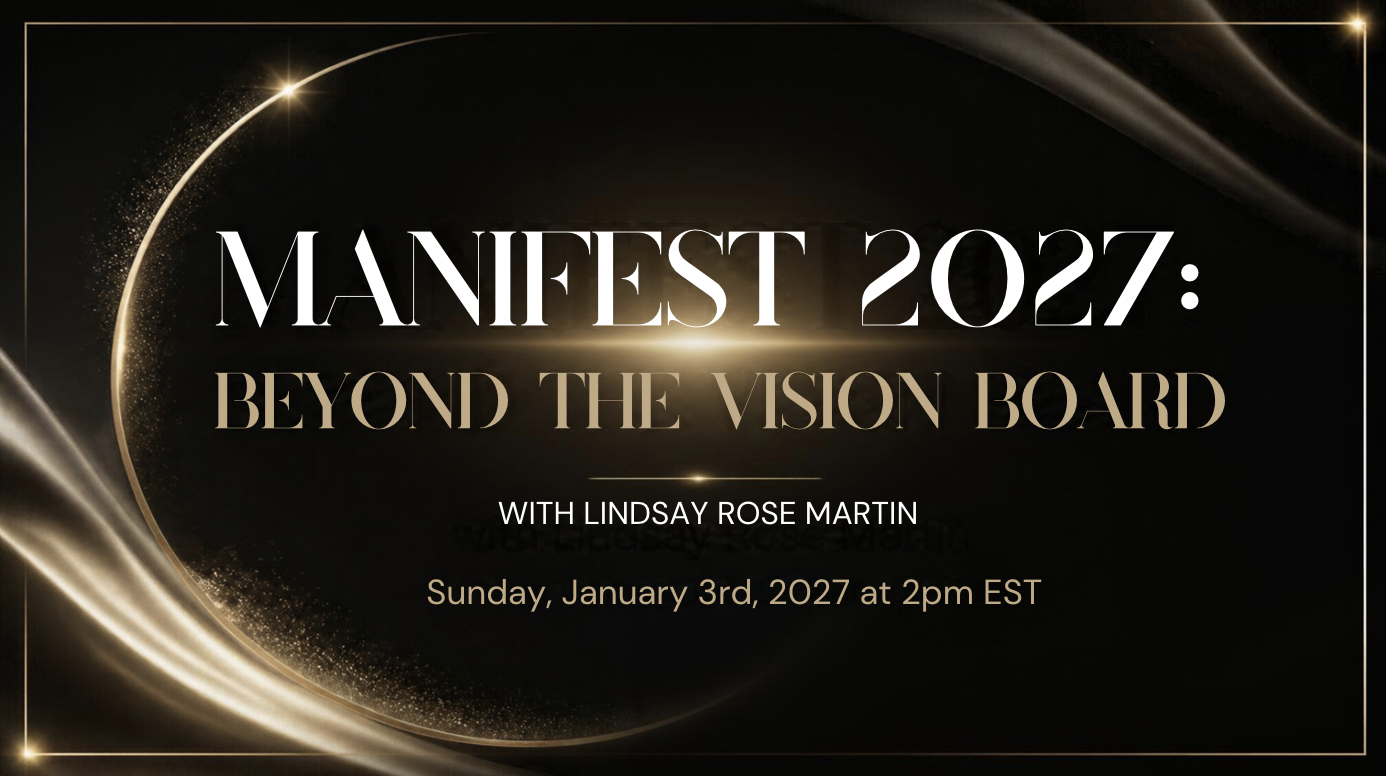
Save Your Seat for Manifest 2027
This live online workshop is not about creating a beautiful vision board or writing down another list of goals. It's about getting crystal clear on what you really want, and actually getting results.
Join Lindsay on January 3rd! Save your seat today.